Abstract, Script and Storyboards:
Abstract:
Inspired by the creator’s own struggle with mental illness, the story follows a young boy caught in the midst of a psychotic break as we witness him struggle to discern his internal hallucinatory world from that of objective reality; and, while following him as he descends through a seemingly endless labyrinth of equally terrifying and fantastical hallucinations, the piece attempts to glimpse into the fabric of a mind haunted by insanity—one in which the boundaries of reality itself have become ambiguous. From surrealist mountain vistas to psychedelic fractals to an abandoned spaceship floating amidst the cosmos, the character is transported further and further into the haunted recesses of his twisted psyche-plane, and, ultimately, is forced to make a choice—between the will to power and the will to death.
In this way, the project attempts to make the essential invisibility of mental illness visible (and relatable) to the average, neurotypical viewer; and, in creating this empathetic link between the sane and the insane, it strives to restructure, humanize, and normalize the social taboos surrounding mental illness itself—while also exploring the nature of life, death, and the essential social incompatibility between a schizophrenic mind and the impositions of its collective society.
Script:
Scene 1: Hallucinatory Landscape
Title: Soliloquy of the Drowning Man
Total Estimated Runtime: ~3 and a half minutes
Shot 1:
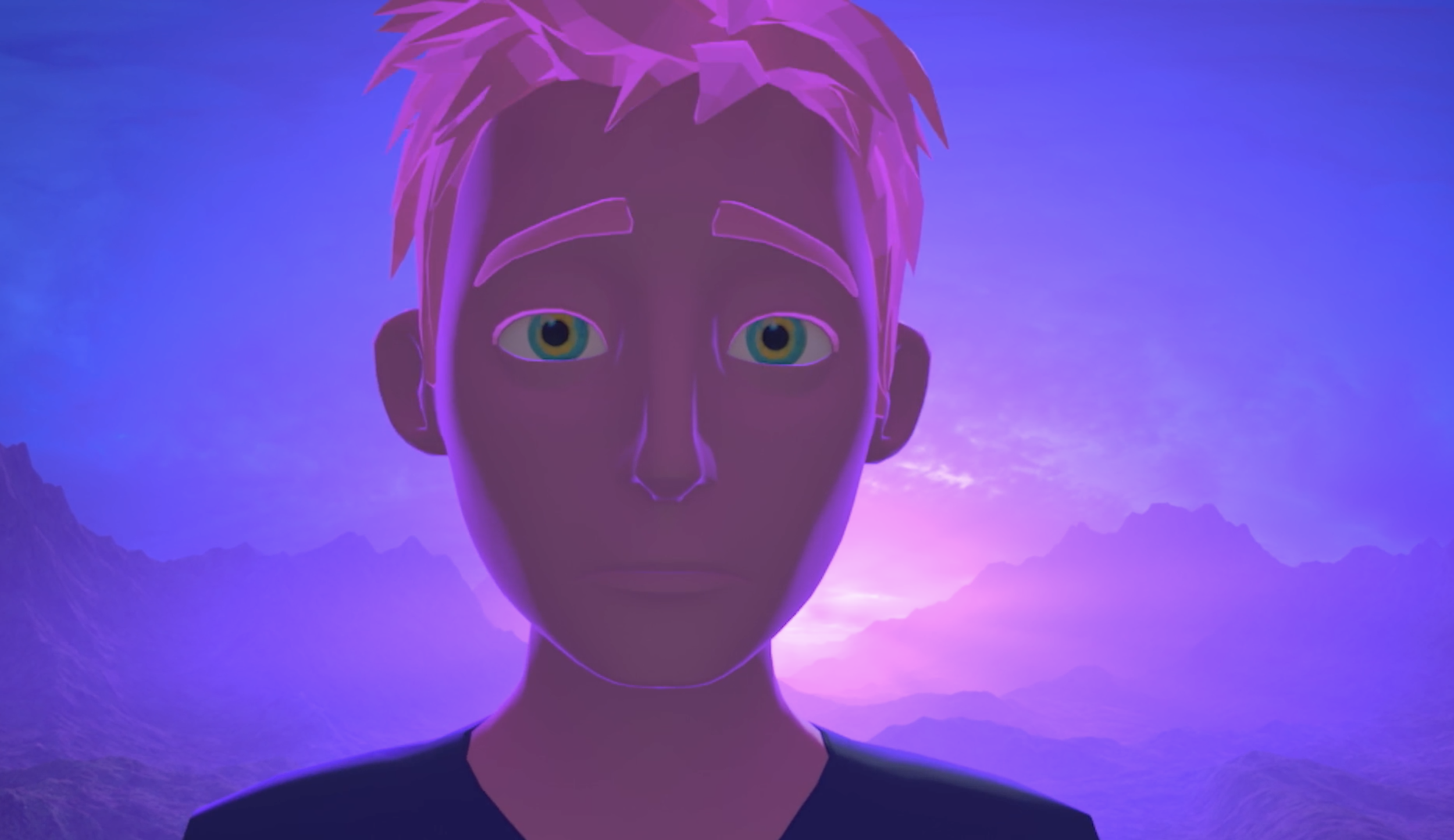
Face in from black. We see a closeup of a man’s face, alit with purple light from a distant and yet indiscernible source, with his green eyes wide and a seemingly placid smile spread across his face.
Shot 2:
The scene then cuts to a mid-range shot as the camera dollies slowly forward through a grassy meadow dotted with purple flowers and oak trees swaying slowly in the breeze, with crepuscular, atmospheric god rays streaming above from the setting sun.
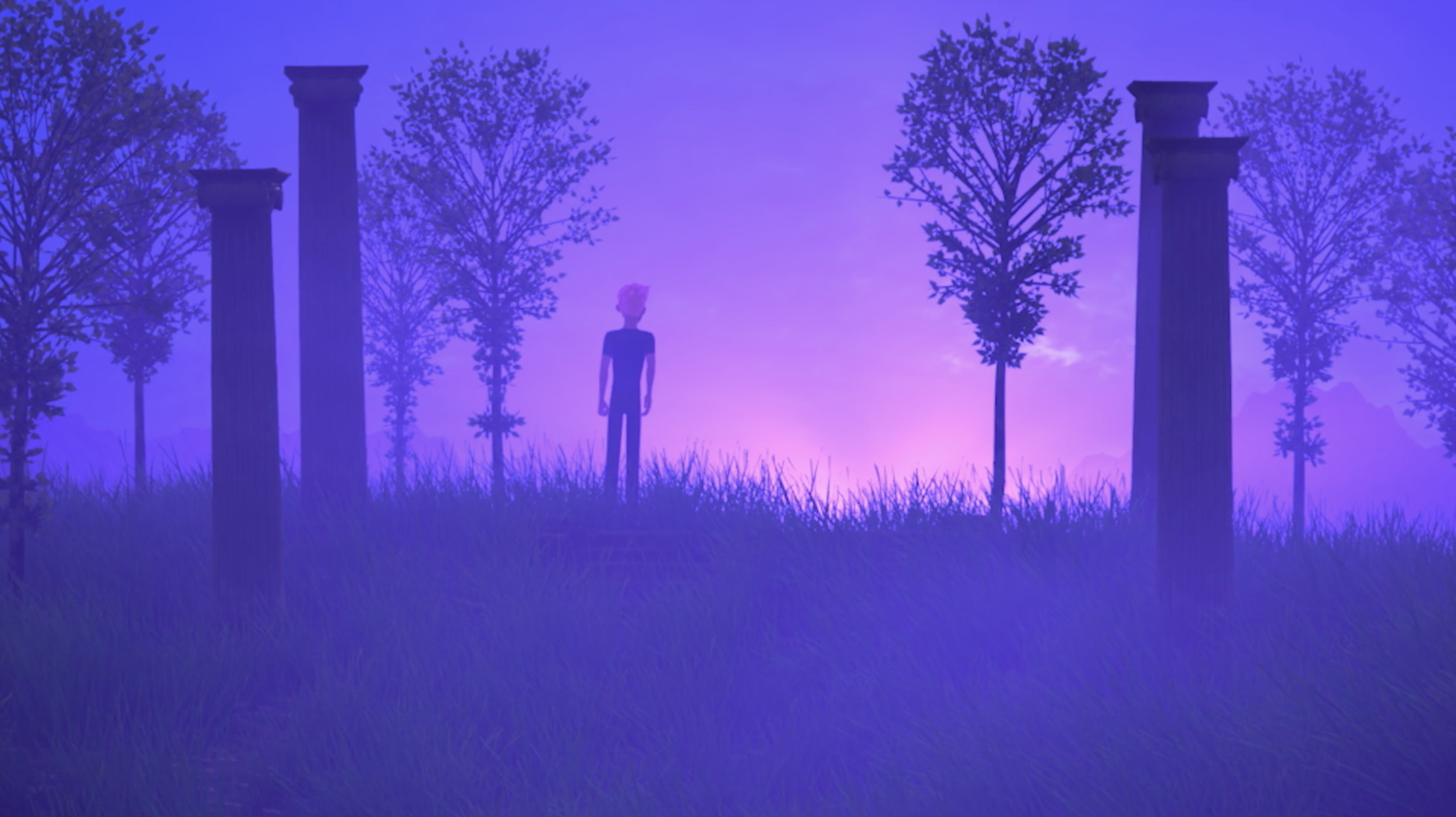
The camera continues in this manner, pressing forward slowly and following a dirt path as it meanders through a thicket of trees, up a steep grassy slope, and finally, tilted upwards due to the incline, coming to a gradual stop at a series of dilapidated ruins atop the hill—where we see our character standing at the top of a series of stone steps between two ivy-clad corinthian columns, framed in a near-silhouette against the setting sun’s purple rays.
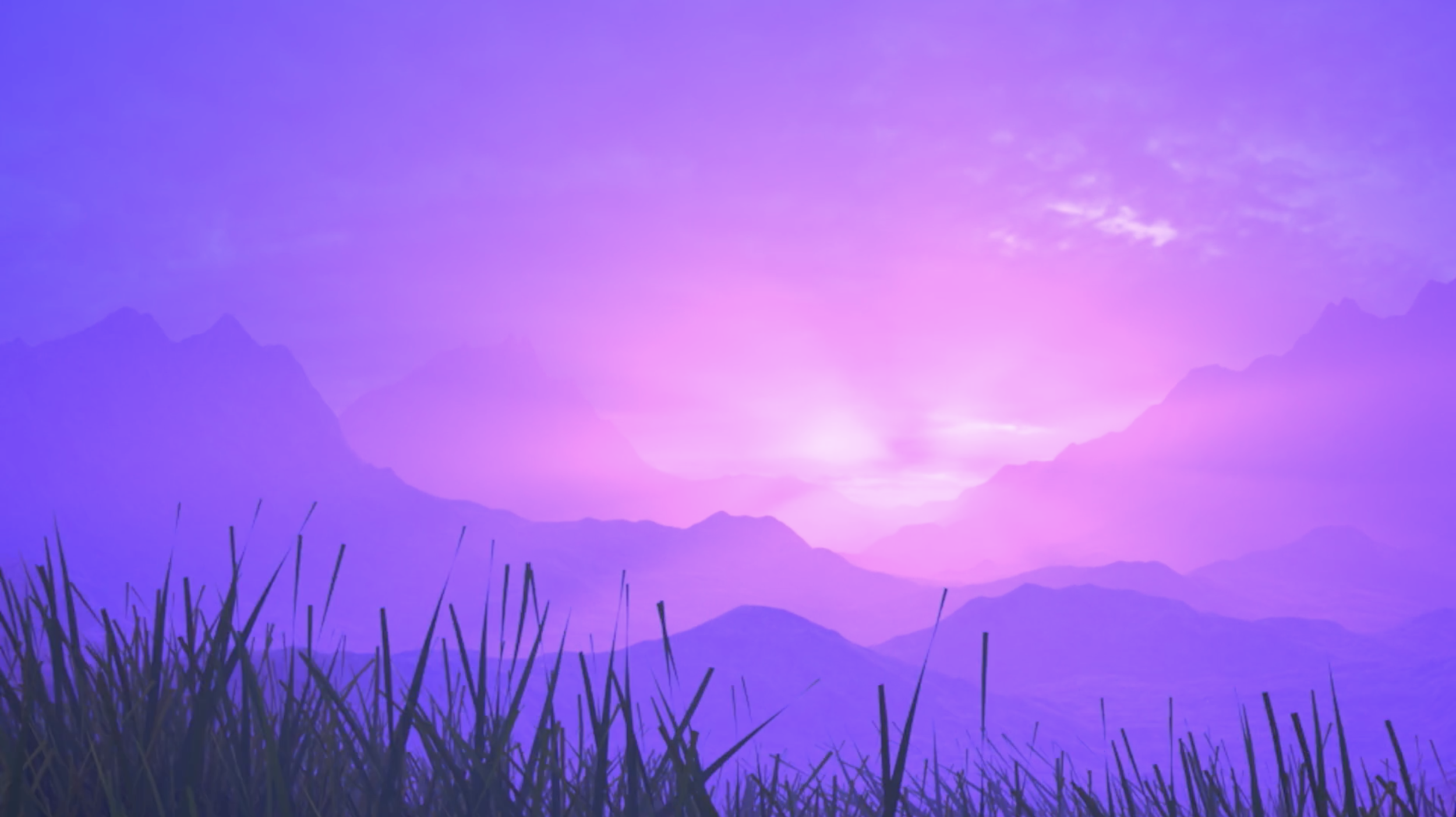
The man begins to walk now, and the camera follows him, finally passing over the crest of the hill (and the ruins) where we see a mountain range in the distance and a purple, surreally gorgeous (and unrealistically saturated) setting sun framed between two peaks in the middle of the frame.
Shot 3:
The man comes to a stop, and we again cut to a close-up of his face, yet this time it looks disturbed, not placid as before, seemingly troubled by something internal.
Shot 4:
The setting sun begins to darken and the fantastical crepuscular beams of light fade, and a darkness now amasses amidst the mountain peaks.
Shot 5:
Another mid-range shot of the man’s face that slowly zooms into his eyes, and this time he looks even more dejected and disturbed than before. The background begins to dissolve away, transitioning seamlessly to a compositionally-similar shot of his face in the next scene.
Scene 2: Back To Reality In Character’s Apartment (Bathroom)
Audio: Audio plays over the course of the scene (~30 seconds) of the character speaking in a hushed voice, reciting some broken form of poetry or verse (that he has seemingly written or memorized), and thereby subliminally manifesting his disturbed interiority and current state of emotional turbulence:
I am a canvas upon which the world paints its madness,
I am the empty page, the spurted ink, the written word, and its final utterance,
I once thought myself to be the painter, yet found myself to be but a brushstroke,
I once dreamed myself the author, yet awoke as but a syllable in another's diction,
Or perhaps a sentence—soon to be scratched out—in a never-to-be-finished work of fiction
Yet I'd rather be a spot of ink…on a dusty page…in an endless library of unread tomes…
Than the creator of all this mischief, the architect of this labyrinth of pain...
For if God be an author, he is surely a sadist.
Shot 1:
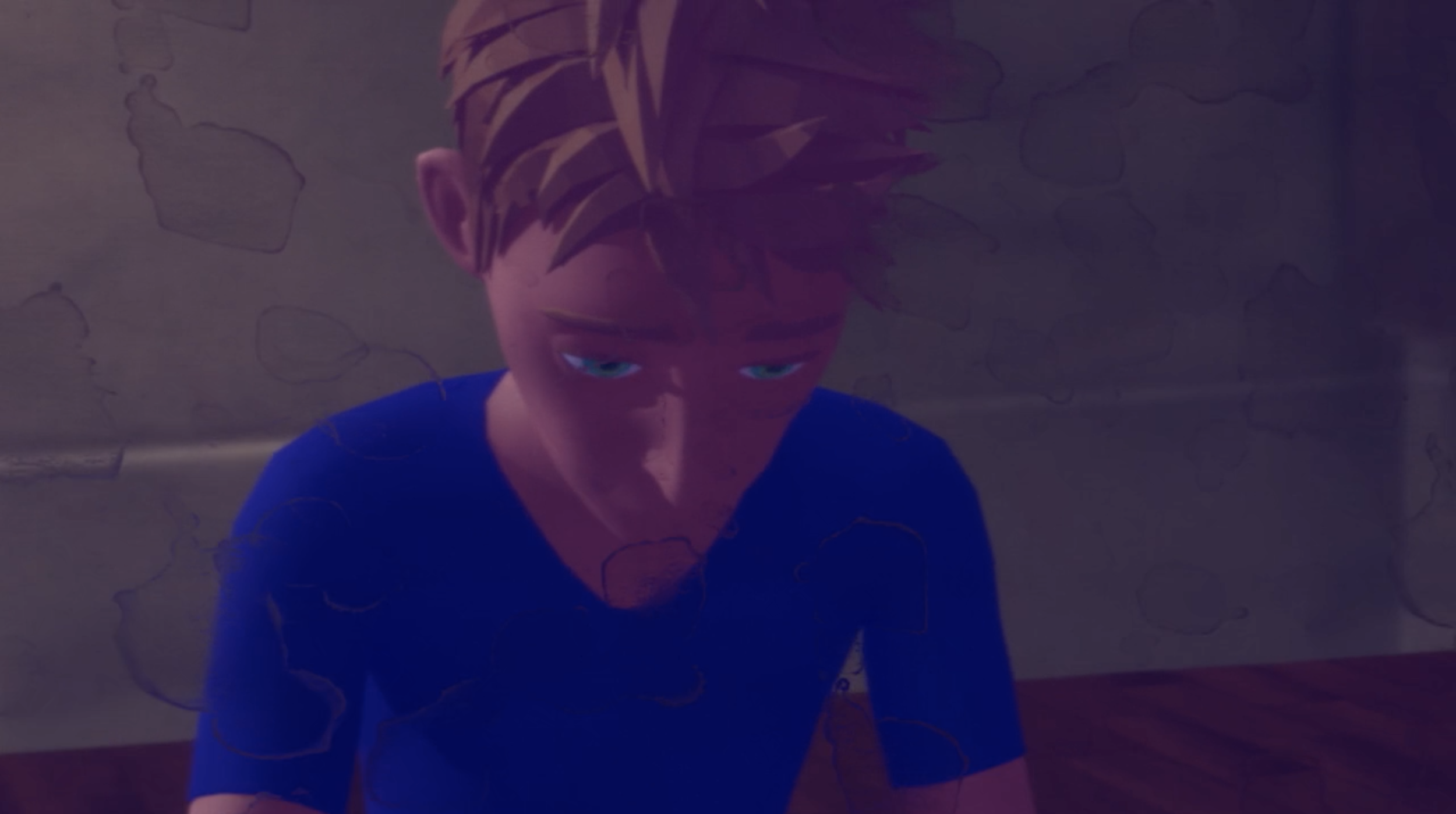
In a seamless transition from the previous close-up of the character’s face as he stood atop the mountain (and in a state of obvious emotional distress), we now dissolve to another closeup of the character’s face with a macro lens—this time peering into a grungy mirror, his eyes gazing directly into the camera (—and with the camera’s frame angled directly forward).
Shot 2:
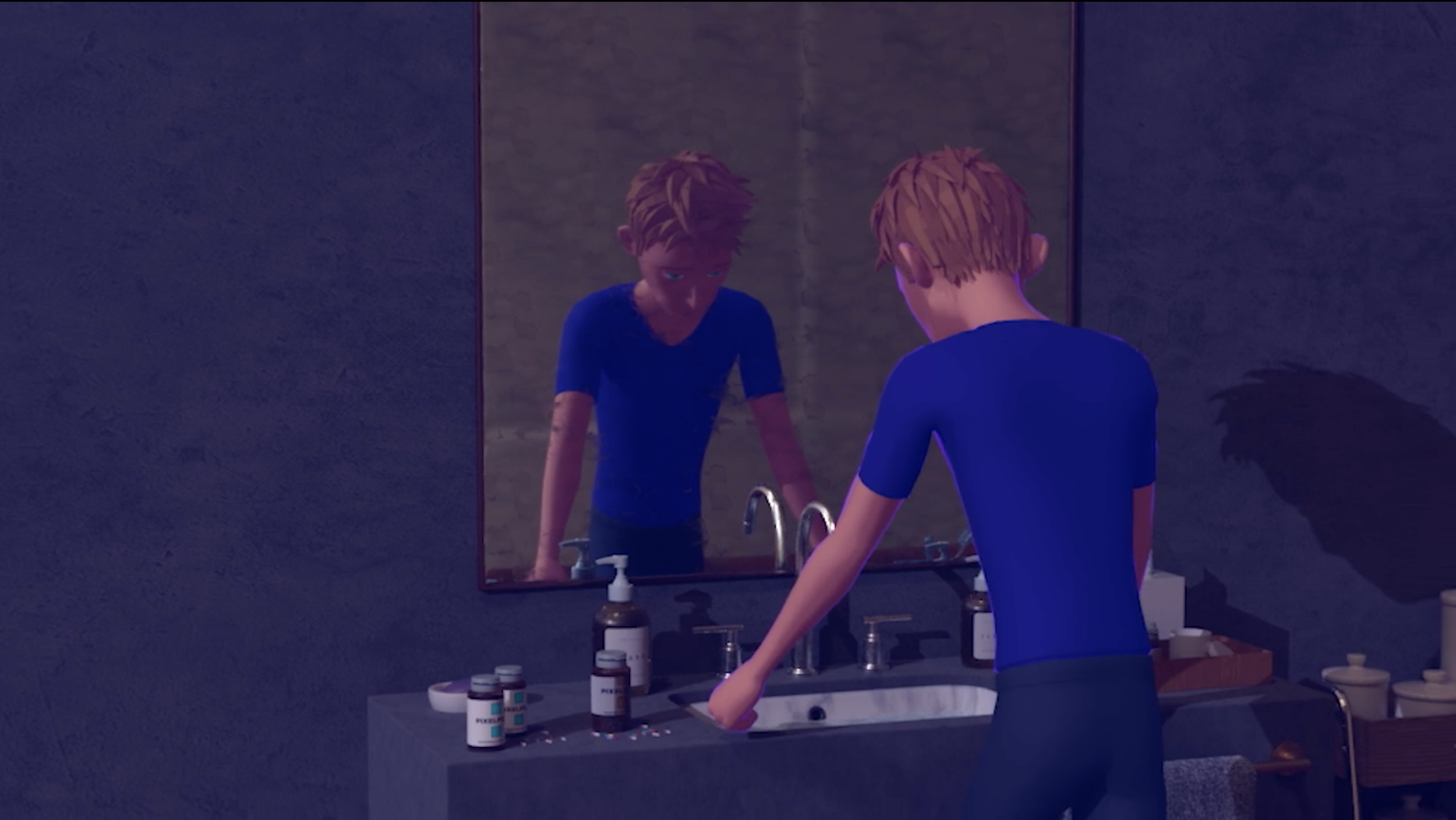
The camera begins to slowly zoom out from the mirror to reveal the character’s surroundings (—now framed in a perspective view with a wider angle lens and without any bokeh in the background.)
The character’s eyes move downwards as his head tilts, and the camera zooms out from the grungy mirror and over his shoulder to reveal a dimly-lit bathroom—with bare concrete walls and a white-tiled floor; the boy is slumped over a sink filled with filthy water, and the surface of the countertop is littered with medication bottles, pills, and various other bathroom-related objects.
Shot 3:
We now cut to a shot from above of the character’s hands after he has clearly doled out his daily round of prescribed medications—and there are a ton. Antipsychotics, mood-stabilizers, antidepressants and amphetamines—happy pills and sad pills and uppers and downers. He holds the seemingly mountainous pile of pills cupped in one hand, with a medication bottle in the other. But we do not see him take them.
Scene 3: Bedroom + Living Room—
(A Sense Of Normalcy; The Character’s Typical Daily Routine)
We now see a series of shots of the character going about his daily routine through various rooms in the interior of his apartment—without any clear sense of time or space utilized in the montage, creating a sense of normalcy for the viewer (in witnessing his habits) and establishing him as being misanthropic, socially-isolated, and clearly depressed (or otherwise mentally-unwell.)
We see a shot of the living room in the character’s apartment—the camera slowly pans around the dimly-lit room, with dirty light filtering in through the blinds of the window, finally resting on a black coffee-table strewn with books, crumpled paper, a sooty astray filled with cigarette-stumps, several translucent plastic canisters of medical marijuana, a green water-pipe filled with nasty bong-water, and, placed casually amidst all of these (somewhat) relatable objects, a black pistol with its cartridge displaced and unloaded.
We see a shot from above of the character sleeping in his bed, with the side-table littered with more medication bottles and other bedroom-related detritus…
We see another shot of him in the bathroom doling out more medication with various pills cupped in his hands, yet again we do not see him take anything…
We see a shot of him lying on the sofa in the living room, with a laptop positioned on his lap, watching some TV show or anime, and in a seeming state of comatose…
We see a shot of him sitting at the desk in his living room, staring blankly into the screen of his desktop computer…
This montage continues thusly for around 30 seconds—without any background audio or non-diegetic sound sources playing save the hum of a white noise machine contrasted with some sort of deep, tonally-disturbing ambient track.
Scene 4: Intro To The Character’s Psyche-Plan—Psychosis Montage
Audio: Audio again begins to play of another verse the character has seemingly written or memorized, again broken and disjointed syntactically, and similarly mixed into the tonally-dissonant background ambient sound-track. The recording plays for around 90 seconds, extending into the next several scenes, with the final lines occurring with the ending of the film.
Tell me, how did it come to this? How did the bright-eyed boy,
smiling so sweetly in that photograph on the windowsill,
become the hollow husk of a man that I am today?
What ill-chosen roads connect us? Where was I led astray?
Tell me: How did it come to this, how did it come to this?
At what point did I stare into the abyss too intensely,
did I become that which I feared so immensely?
From what foul void did the evil inside me slither,
and to what distant land did all goodness flee—reality fissured?
For how long did the darkness inside slowly seep,
for how many years did the monsters within tiptoe and creep?
Did I take too much, give too little, am I the cursed sum of my journey?
Am I a sinner, am I to blame, of Your pity am I even worthy?
Sadly, I have no answers to these queries, since I am
that which haunts me. And I cannot destroy this enemy within,
for it wears my face, speaks my voice, bulges against my very skin.
All that I can do now is hold onto my picture of him:
that bright-eyed boy, smiling sweetly,
desiring not, suffering not, dreaming freely.
Tell me, how did it come to this? How did the bright-eyed boy,
smiling so sweetly in that photograph on the windowsill,
become the hollow husk of a man that I am today?
What ill-chosen roads connect us? Where was I led astray?
Tell me: How did it come to this, how did it come to this?
I remember when the horizon seemed endless, and all roads limitless,
when I felt a sense of purpose, and life was driven by more than mere impetus.
These days, I wake to the world wearily, and count the seconds
as they pass, sitting in my own sweat, feeling the darkness cooly beckon.
These days, I cannot think freely, not without the cold metal barrel
of anxiety pressing into my temple, cautioning me, threatening peril.
I ask myself: Is such a life even worth living in the face of such fears?
Damn the sun and damn the sky! Damn whatever brought me here!
I clench my fists and grind my teeth, and curse them that made me—
and slowly I drift further from the shore...a lonely man, swept out to sea.
Alas! I am the punished and the punisher, a sickly mental masochist,
for I wield a whip in one spectral hand, and absorb its strokes like a pacifist.
I know this cannot be the way: to blindly carry on with such a burden,
so forget me! Forget me entirely! And allow me to slip beneath the surface.
Shot 1:
Upon the completion of the ‘daily routine montage’ in the previous scene—wherein the camera was entirely passive and the narrative without any real sense of time or space—we now see a more active camera as it zooms in from above and focuses on the character, who is again sprawled on his sofa in the living room—in a state of seeming comatose, staring blankly into his laptop’s screen.
Shot 2:
Mid-range shot of the coffee table, as the books strewn haphazardly across it begin to suddenly levitate in the air. The medication bottles and pills begin to levitate too.
Shot 3:
Closeup of the character’s face, no longer comatose and emotionally blank, but now stricken with distress and internal discord. Has he been taking his medications, are they even working? Or has this quickly approaching storm of psychosis and fear been brought about by some other environmental factor? The camera then zooms suddenly into the character’s face and through his skull, passing into darkness as the camera collides with the rig’s geometry and clips into blackness, thus beginning the hallucinatory montage (—and entering his mindscape or psyche-plane.)
Hallucinatory Montage (various shots in rapid order):
Upon passing into his skull and into blackness, we switch from the film’s previously visually-realistic style (—with PBR, physically-realistic textures and lighting—) into a more stylistic and overtly-surrealist aesthetic.
We see a graphic shot displaying the neuron’s within a brain firing, purple light flashing through them (—as a spatial transition from the sudden zoom into the character’s skull.)
A shot of a geometric, psychedelic tunnel pulsating, with its hue rapidly shifting...
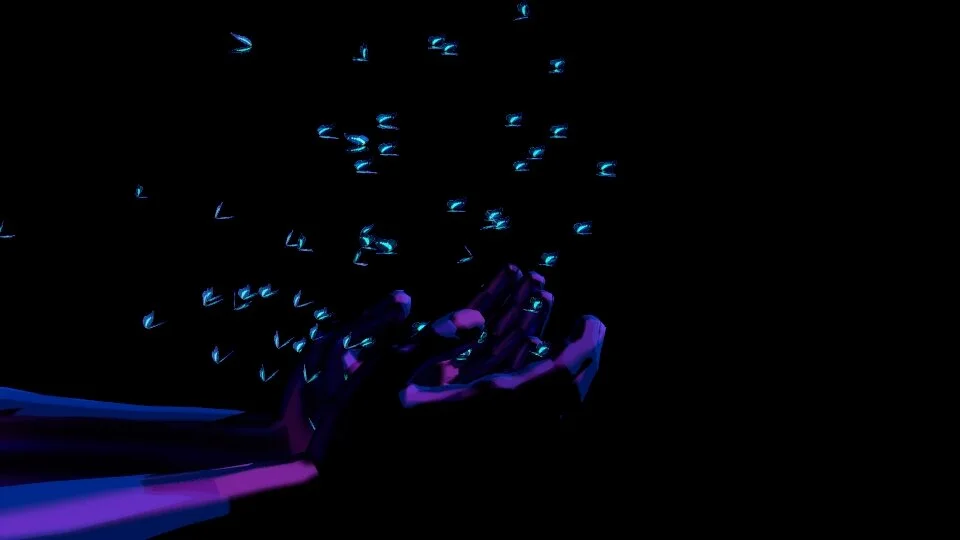
A shot of the character as he holds what looks like pills in his hands that suddenly morph into butterflies that then rise above in a vortex of light…
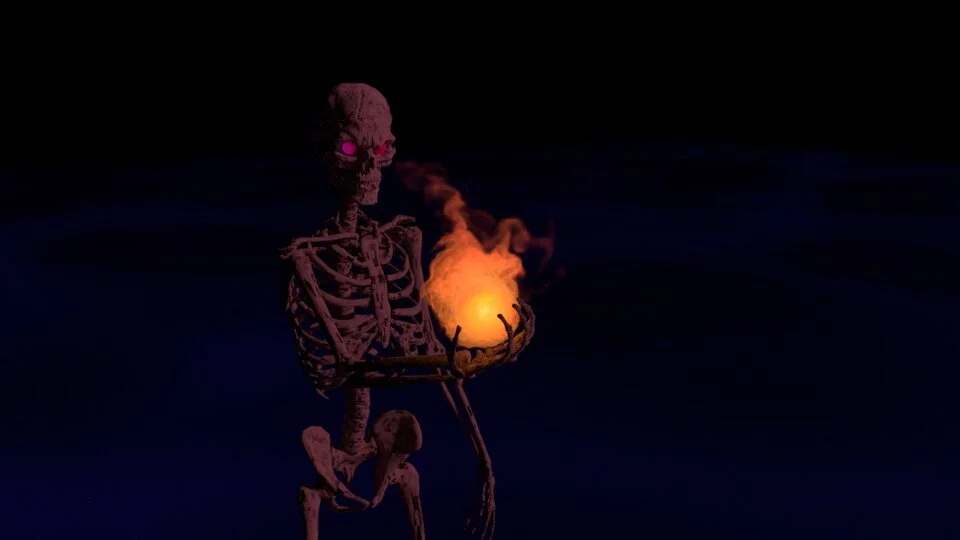
A shot of a skeleton holding a ball of flame…
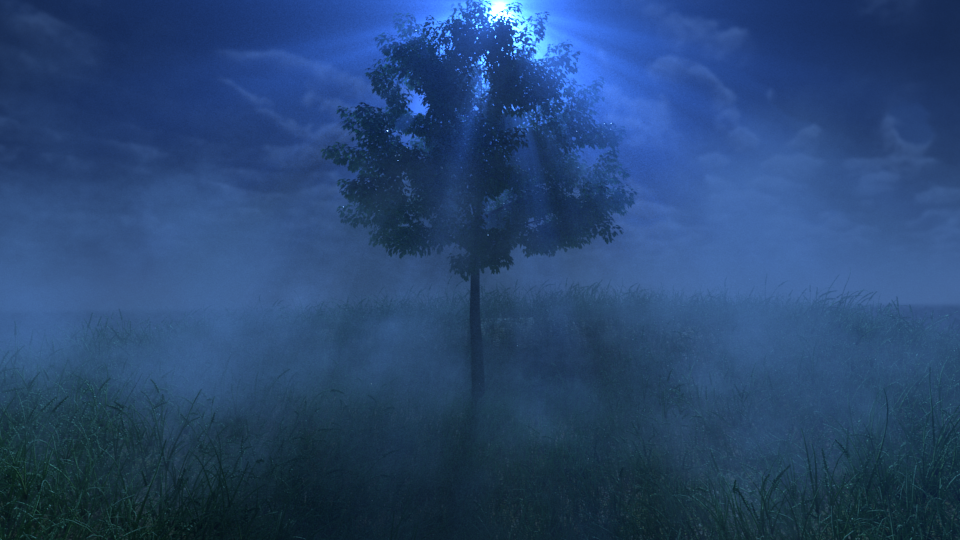
A shot of a tree in a field of grass at night, with moonlight streaming from above, the character silhouetted in the background.
And, finally, the rapid, disjointed cuts come to a sudden stop, and fade to black…
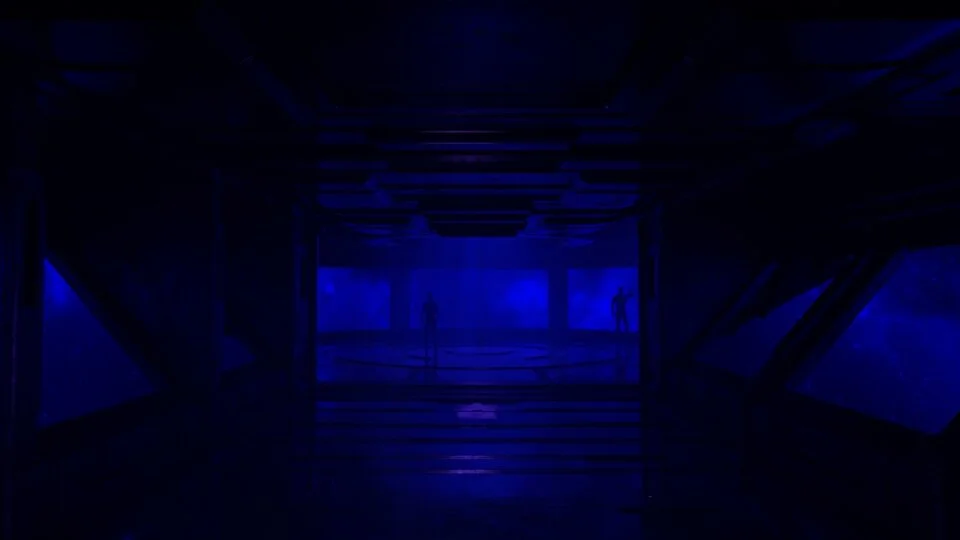
Shot 1 (after montage):
We then fade in from black, and the camera dollies forward through a dark hallway in an unknown space that looks somewhat like a deserted space-station.
The character is positioned in the center of the frame, and he begins to walk forward through the dark hallway, in pace with the camera’s movement, moving slowly towards a room in the distance with strange, frozen figures silhouetted in the volumetric blue light filtering from a skylight in the ceiling above (—with an expansive window in the background letting in the purple-ish light from a distant constellation of stars.)
The camera continues through the hallway, past the walking character, and enters into the room with the strange, frozen figures—slowing down gradually until coming to a stop behind one of the figures, amidst the blue light filtering from above in what resembles the command center of the deserted space-station. The character is no longer in the frame, is nowhere to be scene at all, and the shot fades into blackness.
The audio track of the character reciting his broken, deranged poetry continues to play as before, but now increases in volume, and the previous montage of psychedelic, hallucinatory graphic clips begins to play again, but this time in reverse, and sped up.
Scene 5: Resolution (And Uncertainty)
Shot 1:
We fade dissolve in from the previous shot, zooming out suddenly from the character’s skull and transitioning to a shot of the character (—now situated again in the “real world” in his living room—) in exactly the same position as before, sprawled on his couch, staring into his laptop.
The audio of the poem or verse continues to play discordantly, ever increasing in volume, and now nearing its final lines.
POV Shots:
We see close-up POV shots as the character looks at his medication upon the coffee-table, and then hesitantly at the black pistol placed sinisterly in the background, and then back at his medication, the camera hovering in uncertainty between the two object-correlatives.
Final Shot:
The story ends with the door to the character’s apartment opening, light spilling into the room, washing away the overhanging sense of fear and dread, and the character exiting his cave-like abode—entering into the light of day for seemingly the first time in years; but, after he exits into the light, the camera slowly tracks back to the coffee table, where we see neither of the previous objects that he had been so fixated on (—neither the medications, his potential source of sanity and salvation, nor the weapon, his potential source of self-destruction.)
N.B. The ending of the story at this point is yet undetermined and undecided; I would prefer not to end on such a dramatic and clichè note as above, and am currently working on a solution. Any potential feedback about alternate solutions would be greatly appreciated.
Fade to black. Film credits roll.