Overarching Ideas/Concepts (Central to the Piece):
N.B. A lot of what is written below is quite rambling, poorly edited, and slightly unrelated to the current conceptual state of the project in its current state (as my overall concept for the piece has shifted greatly over the course of the past several months when all of this was initially written.) Apologies about that, I will be pruning this page down in the near future!
Overarching Themes:
An Irrational World vs A Rational World—Analog vs Digital; Dionysian vs Apollonian; material existence vs digital existence; mankind’s systems of meaning vs the chaotic void they attempt to compute; digital world is an extension of our attempt to create meaning (but also an extension of the systems of meaning that control/manipulate). The essential conflict defining human nature: the instinct to rebel/destroy vs the instinct to submit/be controlled (thanatos vs eros a la Freud’s Civilization and Its Discontents ).
Consumption vs Creation—there are those who consume and there are those who create
Sensory Perception: An irrational existence=the intake of sensory information.
Disempowerment: Our hero is powerless, passive, a passenger
Counter-culture vs Culture: revolutionary subcultures (and taboo subjects and areas) are either subsumed by the dominant culture or destroyed
Collective Consciousness vs Self-Consciousness
Free-will vs Social Constructs—Social constructs dominate and sap free-will, squashing individuality; they falsely promise freedom and comfort under the guise order and unity—but, in reality, merely enslave those who fall prey to their promises
Technology vs Politics—intersection and collision in ideology (in the direction of future) between technology and politics (i.e. technology tries to liberate while politics tries to manipulate and control)
Surveillance—”Everything is seen, everything is recorded.”
Art vs Advertisement—All postmodern media is used to manipulate and control the (unconscious) consumer; they tell you "YOU are the one!” but in reality they do nothing of the sort,
The Essential ‘Question’
(That I Hope To Answer/Explore and Probe My Audience to Think About As Well):
Life's three greatest questions: “why are we here, how shall we organize ourselves, and what shall we do with our days?” (Betrand Russel, A History of Western Philosophy.)
Postulation 1 (Why are we here?)
The universe is irrational. Our existence, at a primitive level, consists of the intake and reaction to (random) sensory data. We are programmed to calculate this data and react to it accordingly. The “best” machines survive this process and fulfill the purpose of their existence (i.e. reproduction) by creating new machines with similar attributes. This process of blind biological “progress” continues thusly until one of these sensory-intake-machines becomes more than a machine—self-aware, a creature sophisticated enough to recognize the irrationality/meaninglessness of its existence. This new being, in reaction to an absurdist world without meaning, does the only logical thing, and creates his own system of meaning.
Postulation 2 (How shall we organize ourselves?)
Although our existence is meaningless (reproduction withholding), we (sentient beings) give it meaning by constructing systems of ideals (based upon logical/emotional responses to the chaotic void in which we live) to give it a false sense of structure/order (—in order to make everyone smart enough to realize how meaningless existence is not kill themselves; and also to control and manipulate the sensory-intake-machines.) Given that we are egocentric and solitary, a hierarchy forms in this new “organized,” “ordered” world; a world in which the meaning-makers are treated as Gods—through them flow culture and science and art and the (“capital T”) Truth. The sensory-intake-machines continue onwards as they did before, except, in this new and meretriciously meaningful world, they now function as meaning-intake-machines—their sole purpose being the consumption of culturally-constructed ideals/iconography/propaganda/etc…
Postulation 3 (What Shall We Do With Our Days?)
You either make meaning, or you consume it (—or, in some cases, act as a mediator between the processes of creation and consumption, an unwitting transporter of ‘Truth.’)
If you are a meaning-maker, then you create, if you are a meaning-intake-machine, then you consume. An attempted rebellion against this system of made-up ideals leads to two possible paths—subsumption into the machine itself—wherein the iconography and ideologies of your counter-culture become appropriated by the unconscious meaning-intake-machines, and, thus, now made a part of the greater whole, rendered powerless, impotent, and ineffectual in bringing about change.
The second path, and the most common one (—in which subsumption via appropriation is resisted—) is that of total and absolute destruction (enforced by the superstructure of the machine itself); afterwhich all traces of the counterculture (and its ideals) are made taboo and indelibly wiped from history.
Hierarchies: (Slightly Unrelated To Rest Of Content, But Relates To Above Essential Question)
Meaning-Intake-Machines (The Unconscious Masses):
Purpose: to consume, toil, consume, toil, consume, toil, consume, toil ad infinitum (—also to die and reproduce, of course.)
These unconscious meaning-intake-machines (—who were converted from sensory-intake-machines into meaning-intake-machines upon the rise of sentient meaning-makers—) represent the unintelligent masses—beings too stupid to grasp life’s meaningless, yet too well-programmed to die (and, thus, beings easily manipulated by the sentient meaning-makers, through whom flow culture and art and beauty and who act as the source of truth itself (Kant’s “Ding An Sich”).)
Disseminators/Mouth-Pieces:
Disseminate meaning/iconography/ideals constructed by meaning-makers to the meaning-intake-machines; act as mouthpieces to keep the masses happy while they slowly work themselves to death.
The (illusion of) meaning is disseminated by mouth-pieces in the form of culturally-constructed iconography, mythology, and symbols (—which, to the unintelligent masses, represent only more sensory data—); such constructs subliminally suggest the meaning-intake-machines to consume certain genres of media, to live a certain way, to believe in this and that—promising the common man so much, instilling in him the drive to move ever onwards towards the mirage of progress and all that
is beautiful and lofty upon the horizon(—while, in reality, imprison him, stealing away his identity, etc.
Meaning Mankers:
The meaning-makers, through whom flow beauty and culture and truth; and who act as representations of “The Thing-In-Itself” (What Kant calls “Ding An Sich”). Construct icons/ideals/symbols/etc. which mediators/mouth-pieces disseminate and meaning-intake machines consume.
The Narrative + World:
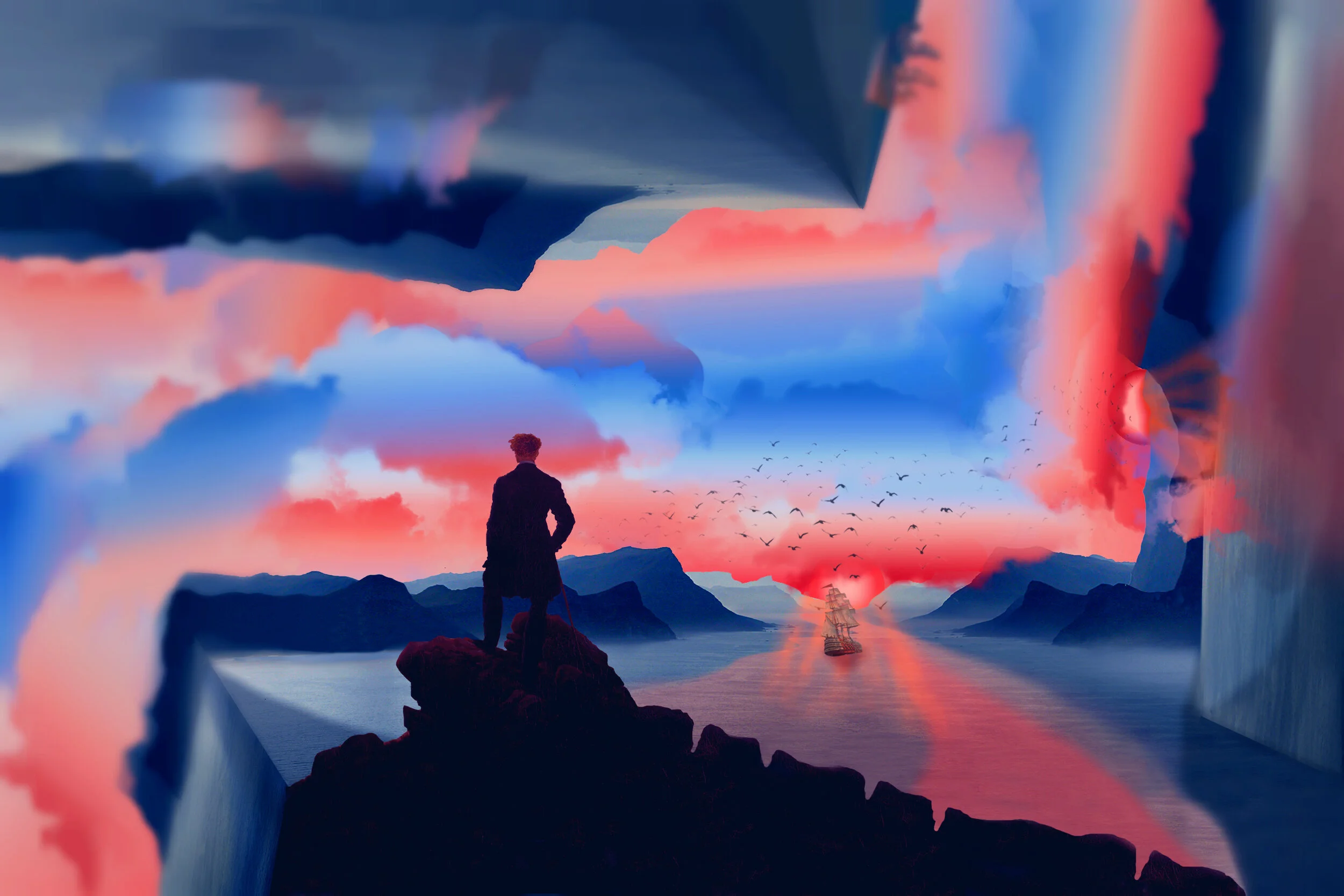
The overarching structure and visual language of the environmental designs mirror Plato’s Allegory of the Cave—with the story starting in a dingy, dark apartment (deep underground); upon the introduction of the inciting incident, the character flees from the ‘underground’ via an ill-fated escape into his psyche-plane. The character believes this world to be a means of escapism and liberation via his own self-derived, self-controlled fantasies(—although ultimately these fantasies are revealed to be specious and inherently at loggerheads with the character’s ‘physical’ and corporeal existence.)
The character mirrors Dostoevsky’s Underground Man in his social isolation, existential dread, and essential incompatibility with his ‘society’ (and its social impositions, edicts, taboos, etc.) And, like the Underground Man, he immersed himself into a state of isolation and estrangement from the real (or ‘above-ground’) world. And, consequently, immersed in his state of misanthropy, social isolation and hatred (or, in reality, fear) of all of mankind, he creates a self-derived mind-scape as a defense mechanism to substitute the vacuum within him—a self-derived, psychotic pysche-plane through which he attempts to escape his corporeal existence (and subconscious desire) to exit the ‘cave’.
The character’s purported mind-scape attempts to act as (and is initially portrayed as) a beauteous escape into fantastical worlds of the character’s own creation. However, in reality, the cerebral world is not of the character’s own creation, and, in reality, is beleaguered by the same problems, parameters, and ‘walls’ as the real world. The character’s escape into his ‘mind-scape’ fails, as he is still being controlled while entering these spaces (as they are, in reality, more strictly codified, overseen, and surveilled than the real world could ever be).
After witnessing the downfall of his purportedly ‘self-derived’ mind-scape, and its true nature, the character flees back to the real world, where we arrive back at the dingy apartment from whence we originally started. The story ends with the door opening, light spilling into room, and the character exiting his cave (or underground habitat) and entering into the light of day; yet the ending also implies the character’s suicide (off-screen and subtle.)
The Protagonist:
Estranged from the world or any concept of reality; living in isolation in a cave-like room (a la Notes From Underground) amidst a labyrinth of metaphorical hall-ways, locked doors, and impediments.
Depressed; seemingly psychotic; misanthropic; overly idealistic; suicidal due to social isolation and lack of contact with other life forms, and the lack of concrete memories about his past (and the context for his current situation)
A narrative of disempowerment—hero is never told of his destiny, is never empowered, is brought into new worlds but always as a stranger. Does not have a destiny, is not given a prophecy by some mysterious figure foretelling his immense power and great deeds…knows nothing of his past and nothing of his future. In this world, everyone is fed a destiny by the machine/government through media/advertisements (YOU are important, YOU are special, YOU are the future…) When everyone is important, no one is.
The hero is not the hero, the universe is the hero; a man is the universe experiencing itself, and the universe is, likewise, a man experiencing it (clichés be damned); …our hero does not change, the world changes—a narrative driven through opening of new worlds as story progresses; hero does not progress, the world itself does. He is a passenger, caught in the flow of the story (absurdism). The aesthetic/location/populace/etc. of the world changes as the narrative unfolds, but our hero stays the same—unbroken, imperfect, and powerless.
Redemption is found through the fabric of the world itself…the universe and its aesthetic reflects the progression in our “hero”/narrative. Redemption is found in the ultimate comprehension of a collective consciousness.
Worlds within worlds existentially: the world of the psyche-plane and that of objective reality; narrative contains layers within layers, the main character descends/ascends through these layers as the story unfolds, and the art style follows these themes. Character enters new reality and spirals downwards into a structured void (a la Dantes Inferno). There is the material world and there is the psyche-plane (order vs chaos; Apollonian vs Dionysian)